
CONTACT US
SEARCH WHAT YOU WANT
Shopping malls rarely offer an uninterrupted cleaning shift. Shoppers, delivery carts, temporary promotions and food-court traffic change the available routes throughout the day. A shopping mall cleaning robot must therefore be judged by how well it works in a shared public space, not just how quickly it crosses an empty corridor.
Start with three different kinds of floor area. Main concourses offer long routes but heavy foot traffic. Entrances collect grit and seasonal moisture. Food-court approaches may have spills that need immediate manual response. Back-of-house corridors can be narrower and busier with deliveries than visitors realise.
Map each zone and mark escalators, stairs, glass partitions, emergency exits and temporary kiosk positions. A robot route should not block evacuation paths or create awkward pinch points. Keep the operating plan flexible enough to exclude event areas when the layout changes.
For ordinary dust and debris, a waterless system can be worth trialling because it does not add cleaning water during its routine dry operation. It is not a substitute for an approved response to drinks, grease or other wet spills. Mall teams usually need both scheduled automated passes and staff who can respond quickly to local incidents.
The SW55 A is presented for commercial settings including shopping malls and provides a smaller body for varied indoor routes. The SW80 A has a wider 850 mm cleaning path and may be worth evaluating on larger open concourses. Measure route width and turning room before choosing solely by published efficiency.
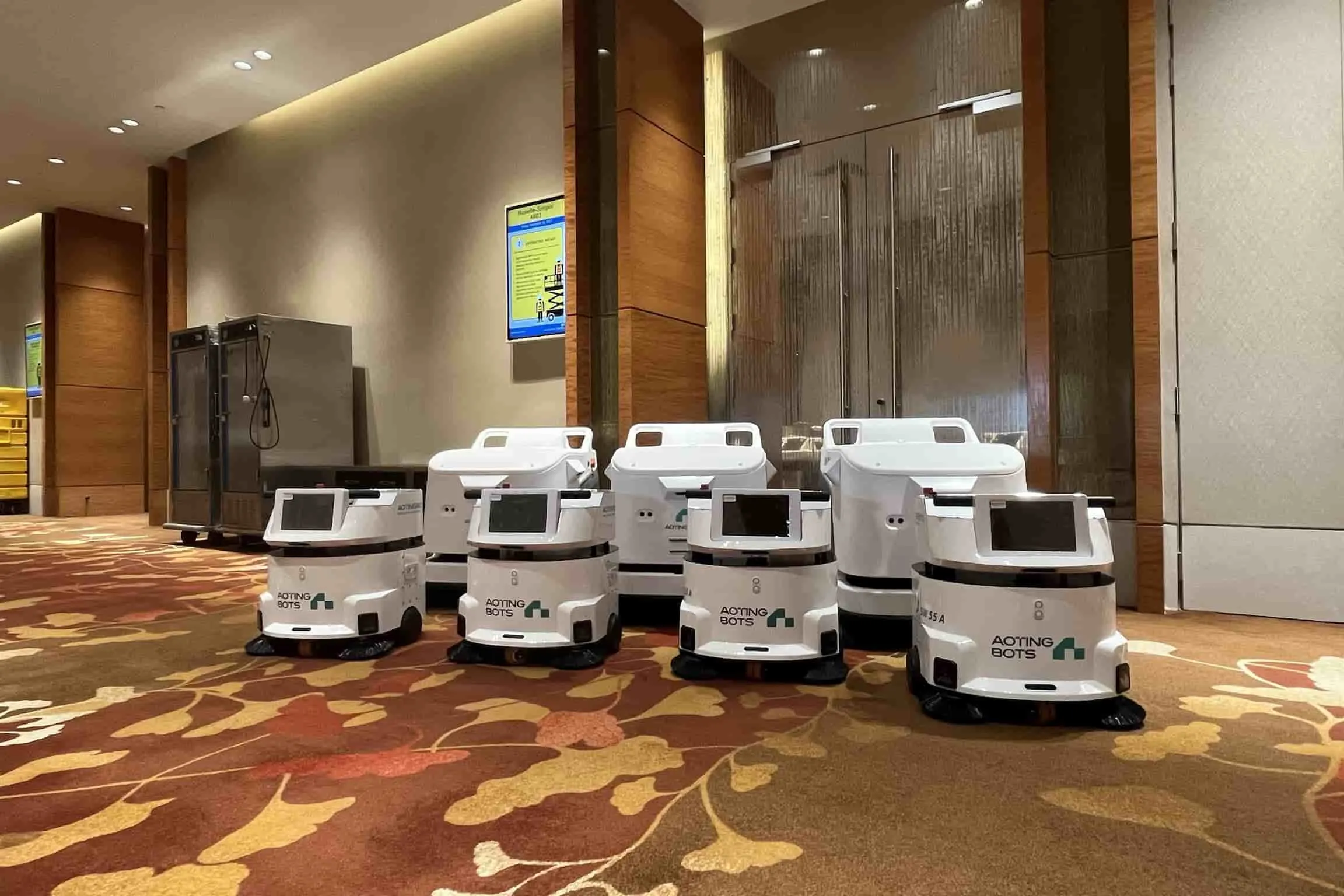
Cleaning equipment operates around people who may not be looking at it. During a trial, observe the machine near families, luggage, pushchairs and queues, with appropriate safety controls and supervision. Record unexpected stops and detours rather than treating them as insignificant. A machine that pauses often in a congested zone might be better scheduled before opening hours.
Noise also matters in restaurants and quieter retail areas. Both SW55 A and SW80 A list noise levels no greater than 62 dB(A) in their published specifications; actual perception depends on the mode, flooring and surroundings.
IEC 63327:2021 addresses particular safety requirements for commercial automatic floor-treatment machines, including their operation near people. Buyers should request applicable compliance evidence for the product and market, not infer certification from a general standards reference.
A practical schedule might reserve long concourse routes for early opening or late evening, with shorter spot routes during quieter periods. Revisit the map after holiday decorations, retail refits or promotional stands are installed. Assign staff to empty debris containers and review incomplete routes at the end of each shift.
AotingBots has reported a commercial robot deployment in Shenzhen shopping centres. It is a brand-reported case example, not independent proof of performance at every mall, but it illustrates the kinds of busy retail environments where a pilot is relevant.
Ask for a demonstration on the busiest permitted route; documented behaviour around pedestrians; usable cleaning width next to walls; waste handling; staff override procedures; and service support during peak seasons. Request a map-editing demonstration because mall layouts rarely stay fixed.
During a holiday campaign, a mall may install kiosks directly beside the normal cleaning route. The usable corridor can become narrower and pedestrian flow can shift toward a different entrance. Before the campaign opens, staff should review route maps, blocked areas and the position of the charger. A short supervised test may show that an early-morning route is more productive than a daytime run. After promotions are removed, restore and verify the appropriate map version rather than assuming the robot will automatically recover the original plan without inspection.
Can a robot clean while the mall is open?
Some systems can be scheduled during opening hours, subject to site risk assessment and route conditions. Busy zones may still be better cleaned outside peak times.
Is a larger model always preferable?
No. A wider path can help on open concourses, while tighter service corridors and changing displays may favour a smaller body.
For shopping malls, choose a machine that can finish useful work without disrupting visitors or staff. That is a more meaningful buying criterion than maximum published speed.
Shopping malls rarely offer an uninterrupted cleaning shift. Shoppers, delivery carts, temporary promotions and food-court traffic change the available routes throughout the day. A shopping mall cleaning robot must therefore be judged by how well it works in a shared public space, not just how quickly it crosses an empty corridor.
Start with three different kinds of floor area. Main concourses offer long routes but heavy foot traffic. Entrances collect grit and seasonal moisture. Food-court approaches may have spills that need immediate manual response. Back-of-house corridors can be narrower and busier with deliveries than visitors realise.
Map each zone and mark escalators, stairs, glass partitions, emergency exits and temporary kiosk positions. A robot route should not block evacuation paths or create awkward pinch points. Keep the operating plan flexible enough to exclude event areas when the layout changes.
For ordinary dust and debris, a waterless system can be worth trialling because it does not add cleaning water during its routine dry operation. It is not a substitute for an approved response to drinks, grease or other wet spills. Mall teams usually need both scheduled automated passes and staff who can respond quickly to local incidents.
The SW55 A is presented for commercial settings including shopping malls and provides a smaller body for varied indoor routes. The SW80 A has a wider 850 mm cleaning path and may be worth evaluating on larger open concourses. Measure route width and turning room before choosing solely by published efficiency.
Cleaning equipment operates around people who may not be looking at it. During a trial, observe the machine near families, luggage, pushchairs and queues, with appropriate safety controls and supervision. Record unexpected stops and detours rather than treating them as insignificant. A machine that pauses often in a congested zone might be better scheduled before opening hours.
Noise also matters in restaurants and quieter retail areas. Both SW55 A and SW80 A list noise levels no greater than 62 dB(A) in their published specifications; actual perception depends on the mode, flooring and surroundings.
IEC 63327:2021 addresses particular safety requirements for commercial automatic floor-treatment machines, including their operation near people. Buyers should request applicable compliance evidence for the product and market, not infer certification from a general standards reference.
A practical schedule might reserve long concourse routes for early opening or late evening, with shorter spot routes during quieter periods. Revisit the map after holiday decorations, retail refits or promotional stands are installed. Assign staff to empty debris containers and review incomplete routes at the end of each shift.
AotingBots has reported a commercial robot deployment in Shenzhen shopping centres. It is a brand-reported case example, not independent proof of performance at every mall, but it illustrates the kinds of busy retail environments where a pilot is relevant.
Ask for a demonstration on the busiest permitted route; documented behaviour around pedestrians; usable cleaning width next to walls; waste handling; staff override procedures; and service support during peak seasons. Request a map-editing demonstration because mall layouts rarely stay fixed.
During a holiday campaign, a mall may install kiosks directly beside the normal cleaning route. The usable corridor can become narrower and pedestrian flow can shift toward a different entrance. Before the campaign opens, staff should review route maps, blocked areas and the position of the charger. A short supervised test may show that an early-morning route is more productive than a daytime run. After promotions are removed, restore and verify the appropriate map version rather than assuming the robot will automatically recover the original plan without inspection.
Can a robot clean while the mall is open?
Some systems can be scheduled during opening hours, subject to site risk assessment and route conditions. Busy zones may still be better cleaned outside peak times.
Is a larger model always preferable?
No. A wider path can help on open concourses, while tighter service corridors and changing displays may favour a smaller body.
For shopping malls, choose a machine that can finish useful work without disrupting visitors or staff. That is a more meaningful buying criterion than maximum published speed.
CONTACT US
we aim to become a global leader in manufacturer space service robotics and artificial intelligence.


