
CONTACT US
SEARCH WHAT YOU WANT
A cleaning robot RFQ (Request for Quotation) should include more than a requested quantity and delivery address. Buyers need to provide facility dimensions, floor types, cleaning tasks, operating schedules, navigation requirements, and expected service conditions.
A well-prepared RFQ helps suppliers recommend suitable equipment and provide quotations with fewer assumptions. It also gives procurement teams a consistent basis for comparing technical capabilities, accessories, installation, warranty coverage, and after-sales support.
For commercial cleaning robots, unclear requirements can lead to unsuitable configurations, unexpected integration costs, and delays during deployment. The following guide explains what information buyers should prepare before requesting a quotation.
A complete cleaning robot RFQ should cover six essential areas:
Buyer and project information.
Facility layout and operating environment.
Cleaning requirements and performance targets.
Technical specifications and integration needs.
Commercial terms and delivery expectations.
Warranty, maintenance, and supporting documentation.
Not every project requires the same level of detail. A single robot for an office building may need a relatively simple specification, while a multi-site warehouse project requires more detailed operational and integration information.
Start with basic project details so the supplier understands the purchasing context.
Include:
Company name and business address.
Contact person's name and position.
Business email and telephone number.
Destination country and delivery location.
Intended application.
Estimated purchasing quantity.
Expected purchasing timeline.
Whether the inquiry is for direct use, distribution, or resale.
Also clarify whether the purchase is a one-time order or part of a larger fleet deployment.
For distributors, it is useful to identify whether the project requires standard equipment, customized branding, or market-specific documentation.
The facility information is often more important than the building's total floor area.
Suppliers need to understand which areas are actually accessible to the robot and which obstacles may affect route planning.
|
Information Required |
Details to Provide |
|---|---|
|
Facility type |
Warehouse, factory, hotel, office, mall |
|
Cleanable floor area |
Actual accessible cleaning area |
|
Floor materials |
Tile, marble, concrete, epoxy, wood, carpet |
|
Number of floors |
Single-level or multi-level |
|
Narrowest passage |
Minimum available access width |
|
Obstacles |
Racks, furniture, machinery, pallets |
|
Traffic conditions |
Employees, forklifts, visitors, AGVs |
|
Operating hours |
Daytime, nighttime, multiple shifts |
|
Cleaning frequency |
Daily, weekly, or scheduled intervals |
A floor plan is particularly useful for large or complex facilities.
Mark charging locations, restricted zones, elevators, access gates, and areas requiring manual cleaning.
For factories and warehouses, provide information about floor slopes, expansion joints, debris, and frequent vehicle movement. These conditions can influence navigation and cleaning performance.
The RFQ should translate cleaning expectations into measurable equipment requirements. Avoid descriptions such as "high efficiency" or "advanced navigation" without defining what the facility actually needs.
Specify the cleaning functions required for the project.
|
Requirement |
Questions to Clarify |
|---|---|
|
Sweeping |
What type and size of debris must be collected? |
|
Vacuuming |
Is fine dust collection required? |
|
Scrubbing |
Is wet cleaning necessary or is waterless cleaning preferred? |
|
Dust mopping |
Are dry floor maintenance functions required? |
|
Edge cleaning |
How close must the robot clean to walls and corners? |
|
Cleaning efficiency |
What daily coverage is expected? |
|
Noise level |
Will the robot operate during business hours? |
|
Floor compatibility |
Which surfaces must it support? |
If the facility has mixed flooring, identify each surface separately. Carpet, marble, hardwood, tile, and epoxy flooring may require different cleaning configurations.
Also distinguish between theoretical cleaning efficiency and required daily output. Published m²/h figures should be evaluated against obstacles, route planning, charging, and actual operating time.
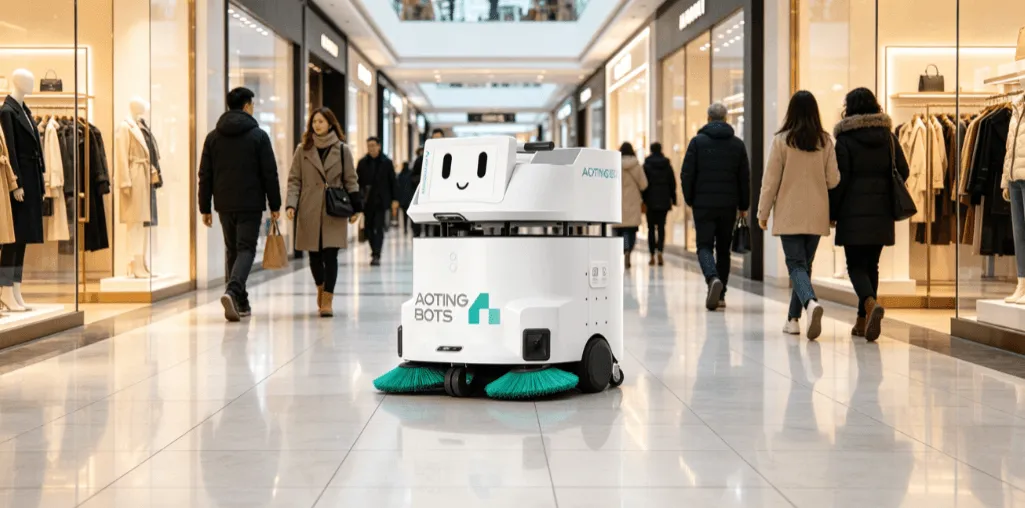
Buyers should identify the technical parameters that directly affect deployment.
Include:
Robot dimensions and weight.
Cleaning width and productivity.
Battery capacity and operating endurance.
Charging time and charging arrangement.
Navigation and positioning technology.
Obstacle detection and avoidance.
Dust collection capacity.
Noise level.
Remote monitoring and reporting.
Elevator and access-control integration.
For example, the AotingBots SW55 A product specifications list a 1,200 m²/h cleaning efficiency, 52 Ah battery capacity, and up to 12 hours of hard-floor endurance.
These values can serve as reference points when defining an RFQ. Buyers should still request confirmation of performance under their own site conditions.
For facilities requiring integration with elevators or access gates, describe the existing control systems and available communication interfaces.
Do not simply write "elevator integration required." Specify the number of elevators, access procedures, control interface, and any building-management restrictions.
Compliance requirements depend on the destination market, equipment configuration, and intended application.
The RFQ should ask suppliers to identify applicable standards and provide supporting documents.
For commercial indoor automatic floor-treatment machines, buyers can refer to IEC 63327:2021, which addresses particular safety requirements for automatic floor-treatment machines.
The standard covers applications including sweeping, scrubbing, and wet or dry pickup. Its requirements work alongside other applicable commercial floor-treatment machine standards.
Product technical datasheet.
Applicable safety certificates.
Relevant test reports.
Electrical specifications.
Battery documentation.
User and maintenance manuals.
Warranty documentation.
Destination-market compliance information.
A standard's relevance does not automatically mean a particular robot is certified to it. Ask the supplier to identify the exact applicable requirements and provide evidence.
Technical suitability alone does not make two quotations comparable. Procurement teams also need a clear breakdown of commercial responsibilities.
Ask suppliers to separate the following quotation items:
|
Quotation Item |
Information to Request |
|---|---|
|
Equipment price |
Model, configuration, and quantity |
|
Accessories |
Standard and optional accessories |
|
Charger |
Included equipment and specifications |
|
Installation |
Mapping, commissioning, and setup |
|
Software |
Licensing and additional service fees |
|
Training |
Training scope and format |
|
Spare parts |
Recommended spare parts and pricing |
|
Warranty |
Duration, coverage, and exclusions |
|
Delivery |
Lead time and shipping arrangement |
|
Payment |
Deposit and balance payment terms |
|
Trade terms |
Applicable Incoterms and named location |
|
Quotation validity |
Validity period and price conditions |
For international purchases, specify the destination port or delivery address.
Also clarify whether the quotation is based on EXW, FOB, CIF, DAP, or another agreed Incoterms rule.
A supplier should distinguish equipment costs from shipping, insurance, customs duties, and local installation charges.
A cleaning robot is operational equipment, not a disposable purchase. Its service arrangements should be clarified before an order is placed.
Ask suppliers:
How long is the standard warranty?
Which components are covered?
Are batteries covered under separate conditions?
Who pays for replacement parts?
Is remote technical support available?
Can spare parts be shipped internationally?
Are maintenance instructions provided?
What happens if the robot stops working during operation?
For distributors, after-sales support is particularly important. They may need spare-parts lists, troubleshooting documentation, and technical training to support customers in their local markets.
Once supplier responses arrive, use a standardized evaluation table rather than choosing the lowest quoted price.
|
Evaluation Category |
Weight |
|---|---|
|
Technical suitability |
25% |
|
Cleaning performance |
20% |
|
Equipment reliability |
15% |
|
Warranty and after-sales support |
15% |
|
Total ownership cost |
15% |
|
Delivery and commercial terms |
10% |
|
Total |
100% |
These weights are an illustrative evaluation framework. Buyers should adjust them according to their operational priorities.
For example, a warehouse operating multiple shifts may assign greater importance to battery endurance and maintenance support.
A hotel may prioritize noise levels, compact dimensions, and elevator integration.
If suppliers use different configurations, request revised quotations based on the same technical requirements. Otherwise, a lower price may simply reflect missing accessories or services.
For additional purchasing considerations, see the commercial cleaning robot manufacturer evaluation guide and commercial cleaning robot price analysis.
The following information can be copied into an email or purchasing document.
Project Information
Company:
Contact Person:
Destination Country:
Facility Type:
Application:
Estimated Quantity:
Expected Purchase Date:
Technical Requirements
Cleanable Floor Area:
Floor Materials:
Required Cleaning Functions:
Cleaning Frequency:
Operating Hours:
Required Cleaning Efficiency:
Navigation Requirements:
Elevator or Access-Control Integration:
Special Environmental Conditions:
Commercial Requirements
Requested Equipment Configuration:
Installation Requirements:
Spare Parts:
Warranty Expectations:
Required Certifications and Documents:
Preferred Delivery Terms:
Destination Address:
Payment Requirements:
Quotation Deliverables
Please provide:
Recommended model and configuration.
Detailed technical datasheet.
Itemized equipment quotation.
Installation and training costs.
Recommended spare-parts list.
Warranty and maintenance conditions.
Estimated production and delivery schedule.
Applicable compliance documentation.
Providing this information at the beginning helps suppliers prepare more relevant quotations and reduces unnecessary clarification rounds.
When preparing a project inquiry, buyers can use the AotingBots commercial cleaning robot product range to identify relevant equipment and review published technical specifications.
The SW55 A is one example for buyers evaluating commercial waterless cleaning applications.
Its published specifications include:
Cleaning efficiency of 1,200 m²/h.
52 Ah battery capacity.
Up to 12 hours of hard-floor endurance.
705 mm cleaning path with the large side brush.
4-in-1 cleaning functions: scrubbing, sweeping, vacuuming, and dust mopping.
Elevator and access-control integration support.
It is designed for medium and small commercial environments, including hotels, offices, shopping malls, and residential communities. Optional functions include security monitoring, inspection, and fire spot detection.
These specifications should be treated as a starting point rather than a complete project proposal.
Buyers should provide their floor plans, cleaning schedules, floor materials, and integration requirements to determine whether the configuration fits the intended application.
For project-specific requirements, use the AotingBots contact page to submit an inquiry and request further product information.
At minimum, provide the facility type, cleanable floor area, floor materials, cleaning requirements, operating hours, destination country, and estimated quantity. A floor plan helps suppliers assess navigation and deployment requirements.
Yes, particularly for large or multi-floor facilities. Floor plans help suppliers identify narrow passages, obstacles, charging locations, restricted areas, and potential elevator integration requirements.
There is no fixed number. Comparing multiple qualified suppliers can help buyers assess technical suitability, pricing, warranty coverage, and after-sales support. All suppliers should receive the same RFQ requirements.
An RFQ primarily requests pricing for defined technical and commercial requirements. An RFP is broader and may ask suppliers to propose complete solutions, implementation plans, service arrangements, and technical approaches.
It should clearly state whether these services are included or charged separately. Buyers should confirm site mapping, commissioning, operator training, and any integration work before accepting the quotation.
Request applicable safety certificates, test reports, electrical documentation, battery documents, and user manuals. The required documents depend on the destination market and the specific equipment configuration.
Buyers can ask manufacturers which configurations and optional functions are available. Requirements such as access-control integration, inspection functions, and application-specific settings should be discussed before quotation approval.
Request an itemized quotation covering equipment, accessories, installation, software, training, spare parts, shipping, warranty, and after-sales support. Confirm which services are included and which require additional payment.
1. IEC 63327:2021 – Automatic Floor Treatment Machines for Commercial Use — International safety requirements for automatic commercial floor-treatment machines.
2. AotingBots SW55 A – Official Product Specifications — Published product parameters, cleaning functions, and application information.
3. Commercial Cleaning Robot Manufacturer: What B2B Buyers Should Evaluate — Supplier evaluation and quotation considerations.
4. Commercial Cleaning Robot Price: What Determines the Total Investment? — Equipment pricing and quotation cost components.
5. AotingBots – Contact and Project Inquiry — Official inquiry channel.
A cleaning robot RFQ (Request for Quotation) should include more than a requested quantity and delivery address. Buyers need to provide facility dimensions, floor types, cleaning tasks, operating schedules, navigation requirements, and expected service conditions.
A well-prepared RFQ helps suppliers recommend suitable equipment and provide quotations with fewer assumptions. It also gives procurement teams a consistent basis for comparing technical capabilities, accessories, installation, warranty coverage, and after-sales support.
For commercial cleaning robots, unclear requirements can lead to unsuitable configurations, unexpected integration costs, and delays during deployment. The following guide explains what information buyers should prepare before requesting a quotation.
A complete cleaning robot RFQ should cover six essential areas:
Buyer and project information.
Facility layout and operating environment.
Cleaning requirements and performance targets.
Technical specifications and integration needs.
Commercial terms and delivery expectations.
Warranty, maintenance, and supporting documentation.
Not every project requires the same level of detail. A single robot for an office building may need a relatively simple specification, while a multi-site warehouse project requires more detailed operational and integration information.
Start with basic project details so the supplier understands the purchasing context.
Include:
Company name and business address.
Contact person's name and position.
Business email and telephone number.
Destination country and delivery location.
Intended application.
Estimated purchasing quantity.
Expected purchasing timeline.
Whether the inquiry is for direct use, distribution, or resale.
Also clarify whether the purchase is a one-time order or part of a larger fleet deployment.
For distributors, it is useful to identify whether the project requires standard equipment, customized branding, or market-specific documentation.
The facility information is often more important than the building's total floor area.
Suppliers need to understand which areas are actually accessible to the robot and which obstacles may affect route planning.
|
Information Required |
Details to Provide |
|---|---|
|
Facility type |
Warehouse, factory, hotel, office, mall |
|
Cleanable floor area |
Actual accessible cleaning area |
|
Floor materials |
Tile, marble, concrete, epoxy, wood, carpet |
|
Number of floors |
Single-level or multi-level |
|
Narrowest passage |
Minimum available access width |
|
Obstacles |
Racks, furniture, machinery, pallets |
|
Traffic conditions |
Employees, forklifts, visitors, AGVs |
|
Operating hours |
Daytime, nighttime, multiple shifts |
|
Cleaning frequency |
Daily, weekly, or scheduled intervals |
A floor plan is particularly useful for large or complex facilities.
Mark charging locations, restricted zones, elevators, access gates, and areas requiring manual cleaning.
For factories and warehouses, provide information about floor slopes, expansion joints, debris, and frequent vehicle movement. These conditions can influence navigation and cleaning performance.
The RFQ should translate cleaning expectations into measurable equipment requirements. Avoid descriptions such as "high efficiency" or "advanced navigation" without defining what the facility actually needs.
Specify the cleaning functions required for the project.
|
Requirement |
Questions to Clarify |
|---|---|
|
Sweeping |
What type and size of debris must be collected? |
|
Vacuuming |
Is fine dust collection required? |
|
Scrubbing |
Is wet cleaning necessary or is waterless cleaning preferred? |
|
Dust mopping |
Are dry floor maintenance functions required? |
|
Edge cleaning |
How close must the robot clean to walls and corners? |
|
Cleaning efficiency |
What daily coverage is expected? |
|
Noise level |
Will the robot operate during business hours? |
|
Floor compatibility |
Which surfaces must it support? |
If the facility has mixed flooring, identify each surface separately. Carpet, marble, hardwood, tile, and epoxy flooring may require different cleaning configurations.
Also distinguish between theoretical cleaning efficiency and required daily output. Published m²/h figures should be evaluated against obstacles, route planning, charging, and actual operating time.
Buyers should identify the technical parameters that directly affect deployment.
Include:
Robot dimensions and weight.
Cleaning width and productivity.
Battery capacity and operating endurance.
Charging time and charging arrangement.
Navigation and positioning technology.
Obstacle detection and avoidance.
Dust collection capacity.
Noise level.
Remote monitoring and reporting.
Elevator and access-control integration.
For example, the AotingBots SW55 A product specifications list a 1,200 m²/h cleaning efficiency, 52 Ah battery capacity, and up to 12 hours of hard-floor endurance.
These values can serve as reference points when defining an RFQ. Buyers should still request confirmation of performance under their own site conditions.
For facilities requiring integration with elevators or access gates, describe the existing control systems and available communication interfaces.
Do not simply write "elevator integration required." Specify the number of elevators, access procedures, control interface, and any building-management restrictions.
Compliance requirements depend on the destination market, equipment configuration, and intended application.
The RFQ should ask suppliers to identify applicable standards and provide supporting documents.
For commercial indoor automatic floor-treatment machines, buyers can refer to IEC 63327:2021, which addresses particular safety requirements for automatic floor-treatment machines.
The standard covers applications including sweeping, scrubbing, and wet or dry pickup. Its requirements work alongside other applicable commercial floor-treatment machine standards.
Product technical datasheet.
Applicable safety certificates.
Relevant test reports.
Electrical specifications.
Battery documentation.
User and maintenance manuals.
Warranty documentation.
Destination-market compliance information.
A standard's relevance does not automatically mean a particular robot is certified to it. Ask the supplier to identify the exact applicable requirements and provide evidence.
Technical suitability alone does not make two quotations comparable. Procurement teams also need a clear breakdown of commercial responsibilities.
Ask suppliers to separate the following quotation items:
|
Quotation Item |
Information to Request |
|---|---|
|
Equipment price |
Model, configuration, and quantity |
|
Accessories |
Standard and optional accessories |
|
Charger |
Included equipment and specifications |
|
Installation |
Mapping, commissioning, and setup |
|
Software |
Licensing and additional service fees |
|
Training |
Training scope and format |
|
Spare parts |
Recommended spare parts and pricing |
|
Warranty |
Duration, coverage, and exclusions |
|
Delivery |
Lead time and shipping arrangement |
|
Payment |
Deposit and balance payment terms |
|
Trade terms |
Applicable Incoterms and named location |
|
Quotation validity |
Validity period and price conditions |
For international purchases, specify the destination port or delivery address.
Also clarify whether the quotation is based on EXW, FOB, CIF, DAP, or another agreed Incoterms rule.
A supplier should distinguish equipment costs from shipping, insurance, customs duties, and local installation charges.
A cleaning robot is operational equipment, not a disposable purchase. Its service arrangements should be clarified before an order is placed.
Ask suppliers:
How long is the standard warranty?
Which components are covered?
Are batteries covered under separate conditions?
Who pays for replacement parts?
Is remote technical support available?
Can spare parts be shipped internationally?
Are maintenance instructions provided?
What happens if the robot stops working during operation?
For distributors, after-sales support is particularly important. They may need spare-parts lists, troubleshooting documentation, and technical training to support customers in their local markets.
Once supplier responses arrive, use a standardized evaluation table rather than choosing the lowest quoted price.
|
Evaluation Category |
Weight |
|---|---|
|
Technical suitability |
25% |
|
Cleaning performance |
20% |
|
Equipment reliability |
15% |
|
Warranty and after-sales support |
15% |
|
Total ownership cost |
15% |
|
Delivery and commercial terms |
10% |
|
Total |
100% |
These weights are an illustrative evaluation framework. Buyers should adjust them according to their operational priorities.
For example, a warehouse operating multiple shifts may assign greater importance to battery endurance and maintenance support.
A hotel may prioritize noise levels, compact dimensions, and elevator integration.
If suppliers use different configurations, request revised quotations based on the same technical requirements. Otherwise, a lower price may simply reflect missing accessories or services.
For additional purchasing considerations, see the commercial cleaning robot manufacturer evaluation guide and commercial cleaning robot price analysis.
The following information can be copied into an email or purchasing document.
Project Information
Company:
Contact Person:
Destination Country:
Facility Type:
Application:
Estimated Quantity:
Expected Purchase Date:
Technical Requirements
Cleanable Floor Area:
Floor Materials:
Required Cleaning Functions:
Cleaning Frequency:
Operating Hours:
Required Cleaning Efficiency:
Navigation Requirements:
Elevator or Access-Control Integration:
Special Environmental Conditions:
Commercial Requirements
Requested Equipment Configuration:
Installation Requirements:
Spare Parts:
Warranty Expectations:
Required Certifications and Documents:
Preferred Delivery Terms:
Destination Address:
Payment Requirements:
Quotation Deliverables
Please provide:
Recommended model and configuration.
Detailed technical datasheet.
Itemized equipment quotation.
Installation and training costs.
Recommended spare-parts list.
Warranty and maintenance conditions.
Estimated production and delivery schedule.
Applicable compliance documentation.
Providing this information at the beginning helps suppliers prepare more relevant quotations and reduces unnecessary clarification rounds.
When preparing a project inquiry, buyers can use the AotingBots commercial cleaning robot product range to identify relevant equipment and review published technical specifications.
The SW55 A is one example for buyers evaluating commercial waterless cleaning applications.
Its published specifications include:
Cleaning efficiency of 1,200 m²/h.
52 Ah battery capacity.
Up to 12 hours of hard-floor endurance.
705 mm cleaning path with the large side brush.
4-in-1 cleaning functions: scrubbing, sweeping, vacuuming, and dust mopping.
Elevator and access-control integration support.
It is designed for medium and small commercial environments, including hotels, offices, shopping malls, and residential communities. Optional functions include security monitoring, inspection, and fire spot detection.
These specifications should be treated as a starting point rather than a complete project proposal.
Buyers should provide their floor plans, cleaning schedules, floor materials, and integration requirements to determine whether the configuration fits the intended application.
For project-specific requirements, use the AotingBots contact page to submit an inquiry and request further product information.
At minimum, provide the facility type, cleanable floor area, floor materials, cleaning requirements, operating hours, destination country, and estimated quantity. A floor plan helps suppliers assess navigation and deployment requirements.
Yes, particularly for large or multi-floor facilities. Floor plans help suppliers identify narrow passages, obstacles, charging locations, restricted areas, and potential elevator integration requirements.
There is no fixed number. Comparing multiple qualified suppliers can help buyers assess technical suitability, pricing, warranty coverage, and after-sales support. All suppliers should receive the same RFQ requirements.
An RFQ primarily requests pricing for defined technical and commercial requirements. An RFP is broader and may ask suppliers to propose complete solutions, implementation plans, service arrangements, and technical approaches.
It should clearly state whether these services are included or charged separately. Buyers should confirm site mapping, commissioning, operator training, and any integration work before accepting the quotation.
Request applicable safety certificates, test reports, electrical documentation, battery documents, and user manuals. The required documents depend on the destination market and the specific equipment configuration.
Buyers can ask manufacturers which configurations and optional functions are available. Requirements such as access-control integration, inspection functions, and application-specific settings should be discussed before quotation approval.
Request an itemized quotation covering equipment, accessories, installation, software, training, spare parts, shipping, warranty, and after-sales support. Confirm which services are included and which require additional payment.
1. IEC 63327:2021 – Automatic Floor Treatment Machines for Commercial Use — International safety requirements for automatic commercial floor-treatment machines.
2. AotingBots SW55 A – Official Product Specifications — Published product parameters, cleaning functions, and application information.
3. Commercial Cleaning Robot Manufacturer: What B2B Buyers Should Evaluate — Supplier evaluation and quotation considerations.
4. Commercial Cleaning Robot Price: What Determines the Total Investment? — Equipment pricing and quotation cost components.
5. AotingBots – Contact and Project Inquiry — Official inquiry channel.
CONTACT US
we aim to become a global leader in manufacturer space service robotics and artificial intelligence.


