
CONTACT US
SEARCH WHAT YOU WANT
A commercial cleaning robot pilot test helps facility managers determine whether autonomous equipment can clean reliably under real operating conditions. Rather than relying on product demonstrations alone, buyers should measure cleaning quality, route completion, navigation reliability, battery performance, and operator intervention.
A successful trial should answer three questions: Can the robot complete the required work? Can it operate safely alongside people and equipment? Does its performance justify further investment?
The goal is not to demonstrate every available feature. It is to establish whether the robot can handle the facility's routine cleaning workload consistently.
Manufacturer specifications describe equipment capabilities under defined conditions. Actual performance depends on the building layout, floor materials, traffic, debris, and cleaning schedule.
A robot may navigate an empty corridor successfully but encounter repeated interruptions during normal business hours.
A practical trial can reveal:
Cleaning areas that remain unfinished.
Navigation problems near furniture or equipment.
Battery limitations during longer cleaning routes.
Unexpected manual intervention.
Maintenance requirements that affect productivity.
Differences between advertised and actual coverage.
Without these observations, procurement decisions may overestimate the robot's operational value.
The Singapore National Environment Agency's guidance on cleaning automation highlights the importance of suitable layouts, maneuvering space, access arrangements, and charging infrastructure.
These considerations should influence the trial design before testing begins.
Set measurable objectives based on the facility's existing cleaning requirements.
For example, a distribution center may prioritize route completion during active warehouse operations. An office building may place greater emphasis on noise and pedestrian safety.
Avoid defining success simply as "the robot completed a cleaning demonstration."
Instead, identify target outcomes for cleaning coverage, cleaning quality, operating time, safety, and staff involvement.
A reliable pilot begins with a representative test area and a documented performance baseline.
Do not test only the largest, emptiest floor area. Select zones that reflect the facility's normal operating challenges.
Different facilities require different testing priorities.
Warehouses and distribution centers: Test storage aisles, open floors, and areas with regular forklift movement. Focus on dust collection, navigation, and traffic avoidance.
Factories: Select production-side corridors and areas with changing obstacles. Evaluate cleaning quality and operation around manufacturing equipment.
Office buildings: Test lobbies, furnished corridors, and shared areas. Pay attention to noise, pedestrian movement, and navigation around furniture.
Shopping malls: Include public walkways with changing visitor traffic. Observe route completion and obstacle avoidance during representative operating periods.
Hotels: Test lobby floors and shared corridors. Cleaning quality, operating noise, and maneuverability are particularly relevant.
Include narrow passages, floor transitions, and regularly occupied areas when appropriate.
Avoid assigning unapproved hazardous areas to the robot. Cleaning requirements outside its designed capabilities should remain with suitable equipment or trained personnel.
Before introducing the robot, measure how the existing cleaning process performs.
Useful baseline data includes:
Area cleaned per shift.
Manual cleaning hours.
Cleaning frequency.
Cleaning inspection results.
Equipment preparation and maintenance time.
Areas requiring repeated cleaning.
Use the same floor area and comparable operating conditions during the robot trial.
This makes the comparison more meaningful and reduces the risk of attributing unrelated operational changes to automation.
A single short demonstration rarely captures normal operating variability.
A practical trial might include several cleaning cycles across three to five operating days, depending on facility complexity.
The schedule should cover normal cleaning periods and representative traffic conditions.
Record any changes to furniture arrangements, cleaning routes, or operating settings during testing.
Facility managers, cleaning supervisors, and equipment technicians should understand the criteria before testing begins.
Define who will inspect cleaning results, record interruptions, and approve changes to the test configuration.
This prevents the final evaluation from relying solely on impressions or promotional demonstrations.
The strongest evaluation combines objective operating data with direct cleaning inspections.
The following measurements help distinguish real productivity from theoretical capacity.
Record the assigned cleaning area and the area successfully completed.
Cleaning Coverage Rate = Completed Area ÷ Assigned Area × 100%
For example, if a robot completes 2,700 m² of an assigned 3,000 m² area:
The cleaning coverage rate is 90%.
This does not automatically indicate acceptable cleaning quality. Inspect completed areas for remaining dust, debris, and missed edges.
Also calculate effective productivity:
Effective Productivity = Successfully Cleaned Area ÷ Total Task Time
Total task time should include interruptions and necessary operator assistance. Report charging time separately when assessing full-shift productivity.
Observe how the robot responds to normal site activity.
Test conditions may include fixed furniture, moving pedestrians, cleaning carts, narrow doorways, floor transitions, temporary obstacles, and restricted zones.
Record unexpected stops, navigation failures, route deviations, and contact incidents.
Safety checks should be conducted under controlled conditions using the manufacturer's approved procedures. Do not deliberately create hazardous collisions.
The IEC 63327:2021 standard for automatic commercial floor-treatment machines provides a relevant equipment safety reference. Buyers should confirm which requirements apply to the specific model and configuration.
Battery endurance should be measured during representative cleaning tasks rather than inferred entirely from published specifications.
Record operating time per charge, battery level at task completion, charging frequency, and charging duration.
Maintenance observations should include waste collection, brush inspection, filter condition, and operator time spent managing the robot.
A robot with sufficient theoretical runtime may still lose productivity through repeated interruptions or maintenance.
A useful pilot report should capture both measurable performance and operating problems.
Cleaning coverage: Record the percentage of assigned floor area successfully completed.
Effective productivity: Calculate the cleaned area per operating hour, including task interruptions.
Cleaning quality: Inspect finished areas for remaining dust, debris, and missed sections.
Navigation reliability: Record unexpected stops, route failures, and manual recoveries.
Safety: Document observed hazards, contact incidents, and emergency-stop events.
Battery performance: Record actual operating hours and charging requirements.
Operator intervention: Measure the time employees spend assisting or maintaining the robot.
Task completion: Compare successfully completed cleaning tasks against scheduled tasks.
Set acceptance thresholds before the trial using the facility's cleaning standards. There is no single acceptance percentage suitable for every commercial environment.
A robot should be evaluated across repeated operating cycles, not only its best-performing run.
Review performance during quieter periods and normal business activity.
A robot may achieve high coverage overnight but require more intervention during the day. These differences affect staffing and scheduling decisions.
Compare results with the existing cleaning process, including quality, labor requirements, and interruptions.
Not every unsuccessful task indicates unsuitable equipment.
Minor route interruptions may be corrected through updated mapping or changes to cleaning schedules. Insufficient cleaning quality may require adjustments to cleaning settings or a different cleaning method.
However, repeated safety-related incidents, unsuitable floor compatibility, or insufficient physical clearance may require another solution.
Unresolved safety concerns should prevent further deployment until appropriately assessed.
The evaluation should distinguish between technical limitations and operational issues that can be corrected.
The financial evaluation should use actual pilot measurements.
Compare completed cleaning work, labor involvement, maintenance time, and downtime against the baseline.
Do not assume every hour of robot operation creates an equivalent hour of labor savings.
For a broader ownership-cost assessment, the commercial cleaning robot cost analysis explains why equipment pricing must be considered alongside operating requirements.
A robot that performs consistently with limited intervention may provide greater practical value than a faster machine requiring frequent assistance.
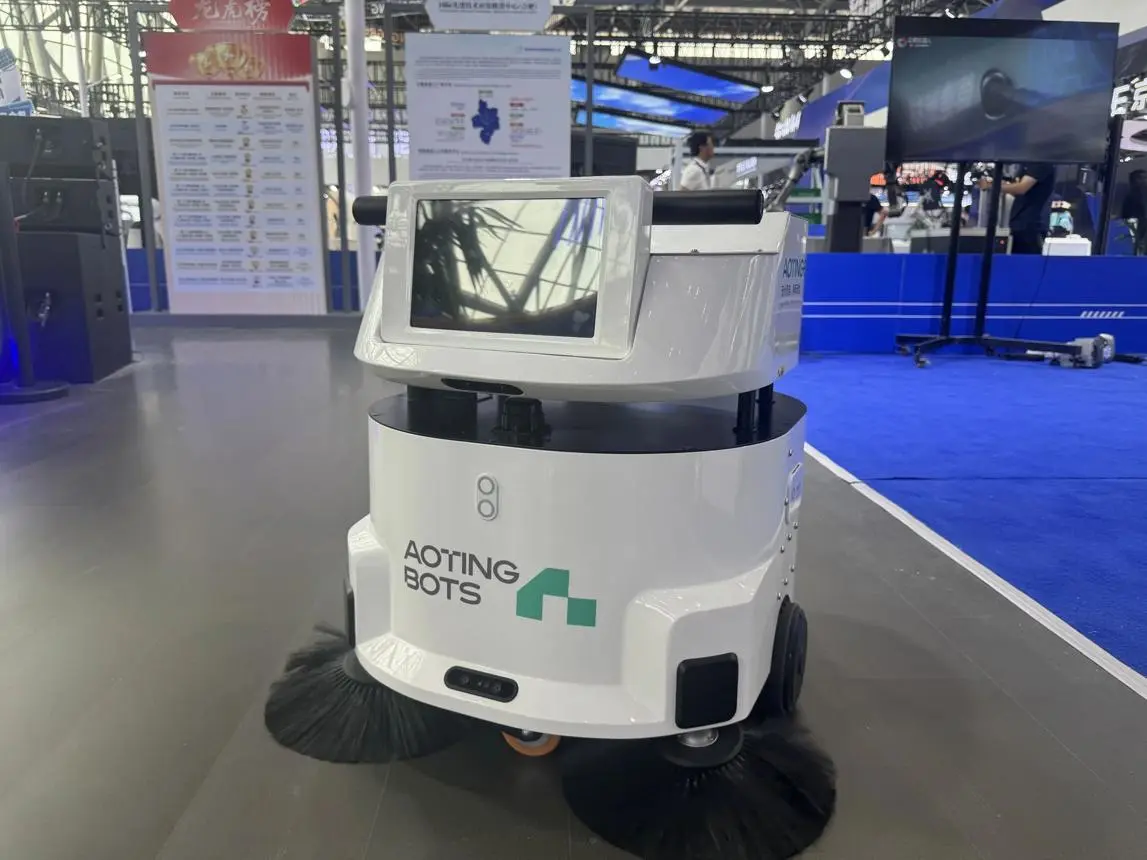
The AotingBots SW55 A commercial cleaning robot provides a useful example of how manufacturer specifications can be converted into practical test objectives.
The SW55 A is a commercial waterless cleaning robot combining sweeping, vacuuming, scrubbing, and dust mopping.
Its published technical specifications include:
Cleaning efficiency: 1,200 m²/h.
Robot dimensions: 615 × 585 × 650 mm.
Cleaning path: 615 / 705 mm.
Battery capacity: 52 Ah.
Hard-floor endurance: Up to 12 hours.
Silent-mode endurance: Up to 16.5 hours.
Charging time: 2 hours.
Mapping capacity: Up to 40,000 m².
Operating noise: ≤62 dB(A).
These are manufacturer specifications, not guaranteed site performance.
For a meaningful SW55 A pilot, buyers should focus on three practical tests.
Cleaning performance: Compare completed floor area and cleaning quality against the facility's existing process.
Navigation reliability: Evaluate route completion around furniture, pedestrians, and other normal obstacles.
Operational workload: Record charging, waste handling, maintenance, and staff intervention across repeated cycles.
The robot supports laser and multi-sensor positioning, dynamic map updates, and remote task management. These capabilities should be evaluated using actual facility routes.
Its published applications include offices, hotels, shopping malls, and other medium-sized commercial environments.
Facilities with more complex layouts may also benefit from reviewing the commercial building cleaning robot selection guide, which discusses cleaning requirements, building integration, and site-specific evaluation.
The facility manager should retain a short trial report containing the test area, cleaning settings, recorded metrics, problems, corrective actions, and final assessment.
For any unresolved issue, document whether another trial or different equipment configuration is necessary.
A controlled pilot provides a stronger basis for selecting an autonomous cleaning robot than specification comparisons alone.
A trial should include enough cleaning cycles to represent normal operating conditions. Several days may be suitable for a simple site, while complex facilities may require longer testing.
No single metric provides a complete assessment. Cleaning quality, completed coverage, navigation reliability, safety, and operator intervention should be evaluated together.
Yes, when appropriate safety controls are in place. Testing during representative operating periods helps reveal pedestrian interactions, route interruptions, and practical scheduling limitations.
Measure the successfully cleaned area and divide it by the time required to complete the task. Record interruptions and manual intervention separately to understand actual operating productivity.
Identify the cause before rejecting the equipment. Route configuration or scheduling problems may be correctable, while safety and floor-compatibility limitations may require another solution.
No. A pilot provides evidence under tested conditions but cannot guarantee future reliability. Routine maintenance, layout changes, equipment wear, and operating conditions can affect long-term results.
Prepare a performance scorecard, cleaning inspection results, safety observations, intervention records, maintenance notes, and a list of unresolved issues.
1. IEC 63327:2021 – Automatic Floor Treatment Machines for Commercial Use — Safety requirements relevant to commercial autonomous floor-treatment equipment.
2. Singapore NEA – Guide on Specifications for Outcome-Based Cleaning Contracts, 2026 — Facility suitability and infrastructure considerations for autonomous cleaning.
3. AotingBots SW55 A – Official Product Specifications — Manufacturer specifications, cleaning capabilities, navigation, and operating parameters.
4. AotingBots – Autonomous Cleaning Robot for Commercial Buildings — Site-specific equipment evaluation and commercial building requirements.
5. AotingBots – Cleaning Robot for Distribution Centers — Operational testing considerations for large commercial environments.
A commercial cleaning robot pilot test helps facility managers determine whether autonomous equipment can clean reliably under real operating conditions. Rather than relying on product demonstrations alone, buyers should measure cleaning quality, route completion, navigation reliability, battery performance, and operator intervention.
A successful trial should answer three questions: Can the robot complete the required work? Can it operate safely alongside people and equipment? Does its performance justify further investment?
The goal is not to demonstrate every available feature. It is to establish whether the robot can handle the facility's routine cleaning workload consistently.
Manufacturer specifications describe equipment capabilities under defined conditions. Actual performance depends on the building layout, floor materials, traffic, debris, and cleaning schedule.
A robot may navigate an empty corridor successfully but encounter repeated interruptions during normal business hours.
A practical trial can reveal:
Cleaning areas that remain unfinished.
Navigation problems near furniture or equipment.
Battery limitations during longer cleaning routes.
Unexpected manual intervention.
Maintenance requirements that affect productivity.
Differences between advertised and actual coverage.
Without these observations, procurement decisions may overestimate the robot's operational value.
The Singapore National Environment Agency's guidance on cleaning automation highlights the importance of suitable layouts, maneuvering space, access arrangements, and charging infrastructure.
These considerations should influence the trial design before testing begins.
Set measurable objectives based on the facility's existing cleaning requirements.
For example, a distribution center may prioritize route completion during active warehouse operations. An office building may place greater emphasis on noise and pedestrian safety.
Avoid defining success simply as "the robot completed a cleaning demonstration."
Instead, identify target outcomes for cleaning coverage, cleaning quality, operating time, safety, and staff involvement.
A reliable pilot begins with a representative test area and a documented performance baseline.
Do not test only the largest, emptiest floor area. Select zones that reflect the facility's normal operating challenges.
Different facilities require different testing priorities.
Warehouses and distribution centers: Test storage aisles, open floors, and areas with regular forklift movement. Focus on dust collection, navigation, and traffic avoidance.
Factories: Select production-side corridors and areas with changing obstacles. Evaluate cleaning quality and operation around manufacturing equipment.
Office buildings: Test lobbies, furnished corridors, and shared areas. Pay attention to noise, pedestrian movement, and navigation around furniture.
Shopping malls: Include public walkways with changing visitor traffic. Observe route completion and obstacle avoidance during representative operating periods.
Hotels: Test lobby floors and shared corridors. Cleaning quality, operating noise, and maneuverability are particularly relevant.
Include narrow passages, floor transitions, and regularly occupied areas when appropriate.
Avoid assigning unapproved hazardous areas to the robot. Cleaning requirements outside its designed capabilities should remain with suitable equipment or trained personnel.
Before introducing the robot, measure how the existing cleaning process performs.
Useful baseline data includes:
Area cleaned per shift.
Manual cleaning hours.
Cleaning frequency.
Cleaning inspection results.
Equipment preparation and maintenance time.
Areas requiring repeated cleaning.
Use the same floor area and comparable operating conditions during the robot trial.
This makes the comparison more meaningful and reduces the risk of attributing unrelated operational changes to automation.
A single short demonstration rarely captures normal operating variability.
A practical trial might include several cleaning cycles across three to five operating days, depending on facility complexity.
The schedule should cover normal cleaning periods and representative traffic conditions.
Record any changes to furniture arrangements, cleaning routes, or operating settings during testing.
Facility managers, cleaning supervisors, and equipment technicians should understand the criteria before testing begins.
Define who will inspect cleaning results, record interruptions, and approve changes to the test configuration.
This prevents the final evaluation from relying solely on impressions or promotional demonstrations.
The strongest evaluation combines objective operating data with direct cleaning inspections.
The following measurements help distinguish real productivity from theoretical capacity.
Record the assigned cleaning area and the area successfully completed.
Cleaning Coverage Rate = Completed Area ÷ Assigned Area × 100%
For example, if a robot completes 2,700 m² of an assigned 3,000 m² area:
The cleaning coverage rate is 90%.
This does not automatically indicate acceptable cleaning quality. Inspect completed areas for remaining dust, debris, and missed edges.
Also calculate effective productivity:
Effective Productivity = Successfully Cleaned Area ÷ Total Task Time
Total task time should include interruptions and necessary operator assistance. Report charging time separately when assessing full-shift productivity.
Observe how the robot responds to normal site activity.
Test conditions may include fixed furniture, moving pedestrians, cleaning carts, narrow doorways, floor transitions, temporary obstacles, and restricted zones.
Record unexpected stops, navigation failures, route deviations, and contact incidents.
Safety checks should be conducted under controlled conditions using the manufacturer's approved procedures. Do not deliberately create hazardous collisions.
The IEC 63327:2021 standard for automatic commercial floor-treatment machines provides a relevant equipment safety reference. Buyers should confirm which requirements apply to the specific model and configuration.
Battery endurance should be measured during representative cleaning tasks rather than inferred entirely from published specifications.
Record operating time per charge, battery level at task completion, charging frequency, and charging duration.
Maintenance observations should include waste collection, brush inspection, filter condition, and operator time spent managing the robot.
A robot with sufficient theoretical runtime may still lose productivity through repeated interruptions or maintenance.
A useful pilot report should capture both measurable performance and operating problems.
Cleaning coverage: Record the percentage of assigned floor area successfully completed.
Effective productivity: Calculate the cleaned area per operating hour, including task interruptions.
Cleaning quality: Inspect finished areas for remaining dust, debris, and missed sections.
Navigation reliability: Record unexpected stops, route failures, and manual recoveries.
Safety: Document observed hazards, contact incidents, and emergency-stop events.
Battery performance: Record actual operating hours and charging requirements.
Operator intervention: Measure the time employees spend assisting or maintaining the robot.
Task completion: Compare successfully completed cleaning tasks against scheduled tasks.
Set acceptance thresholds before the trial using the facility's cleaning standards. There is no single acceptance percentage suitable for every commercial environment.
A robot should be evaluated across repeated operating cycles, not only its best-performing run.
Review performance during quieter periods and normal business activity.
A robot may achieve high coverage overnight but require more intervention during the day. These differences affect staffing and scheduling decisions.
Compare results with the existing cleaning process, including quality, labor requirements, and interruptions.
Not every unsuccessful task indicates unsuitable equipment.
Minor route interruptions may be corrected through updated mapping or changes to cleaning schedules. Insufficient cleaning quality may require adjustments to cleaning settings or a different cleaning method.
However, repeated safety-related incidents, unsuitable floor compatibility, or insufficient physical clearance may require another solution.
Unresolved safety concerns should prevent further deployment until appropriately assessed.
The evaluation should distinguish between technical limitations and operational issues that can be corrected.
The financial evaluation should use actual pilot measurements.
Compare completed cleaning work, labor involvement, maintenance time, and downtime against the baseline.
Do not assume every hour of robot operation creates an equivalent hour of labor savings.
For a broader ownership-cost assessment, the commercial cleaning robot cost analysis explains why equipment pricing must be considered alongside operating requirements.
A robot that performs consistently with limited intervention may provide greater practical value than a faster machine requiring frequent assistance.
The AotingBots SW55 A commercial cleaning robot provides a useful example of how manufacturer specifications can be converted into practical test objectives.
The SW55 A is a commercial waterless cleaning robot combining sweeping, vacuuming, scrubbing, and dust mopping.
Its published technical specifications include:
Cleaning efficiency: 1,200 m²/h.
Robot dimensions: 615 × 585 × 650 mm.
Cleaning path: 615 / 705 mm.
Battery capacity: 52 Ah.
Hard-floor endurance: Up to 12 hours.
Silent-mode endurance: Up to 16.5 hours.
Charging time: 2 hours.
Mapping capacity: Up to 40,000 m².
Operating noise: ≤62 dB(A).
These are manufacturer specifications, not guaranteed site performance.
For a meaningful SW55 A pilot, buyers should focus on three practical tests.
Cleaning performance: Compare completed floor area and cleaning quality against the facility's existing process.
Navigation reliability: Evaluate route completion around furniture, pedestrians, and other normal obstacles.
Operational workload: Record charging, waste handling, maintenance, and staff intervention across repeated cycles.
The robot supports laser and multi-sensor positioning, dynamic map updates, and remote task management. These capabilities should be evaluated using actual facility routes.
Its published applications include offices, hotels, shopping malls, and other medium-sized commercial environments.
Facilities with more complex layouts may also benefit from reviewing the commercial building cleaning robot selection guide, which discusses cleaning requirements, building integration, and site-specific evaluation.
The facility manager should retain a short trial report containing the test area, cleaning settings, recorded metrics, problems, corrective actions, and final assessment.
For any unresolved issue, document whether another trial or different equipment configuration is necessary.
A controlled pilot provides a stronger basis for selecting an autonomous cleaning robot than specification comparisons alone.
A trial should include enough cleaning cycles to represent normal operating conditions. Several days may be suitable for a simple site, while complex facilities may require longer testing.
No single metric provides a complete assessment. Cleaning quality, completed coverage, navigation reliability, safety, and operator intervention should be evaluated together.
Yes, when appropriate safety controls are in place. Testing during representative operating periods helps reveal pedestrian interactions, route interruptions, and practical scheduling limitations.
Measure the successfully cleaned area and divide it by the time required to complete the task. Record interruptions and manual intervention separately to understand actual operating productivity.
Identify the cause before rejecting the equipment. Route configuration or scheduling problems may be correctable, while safety and floor-compatibility limitations may require another solution.
No. A pilot provides evidence under tested conditions but cannot guarantee future reliability. Routine maintenance, layout changes, equipment wear, and operating conditions can affect long-term results.
Prepare a performance scorecard, cleaning inspection results, safety observations, intervention records, maintenance notes, and a list of unresolved issues.
1. IEC 63327:2021 – Automatic Floor Treatment Machines for Commercial Use — Safety requirements relevant to commercial autonomous floor-treatment equipment.
2. Singapore NEA – Guide on Specifications for Outcome-Based Cleaning Contracts, 2026 — Facility suitability and infrastructure considerations for autonomous cleaning.
3. AotingBots SW55 A – Official Product Specifications — Manufacturer specifications, cleaning capabilities, navigation, and operating parameters.
4. AotingBots – Autonomous Cleaning Robot for Commercial Buildings — Site-specific equipment evaluation and commercial building requirements.
5. AotingBots – Cleaning Robot for Distribution Centers — Operational testing considerations for large commercial environments.
CONTACT US
we aim to become a global leader in manufacturer space service robotics and artificial intelligence.


