
CONTACT US
SEARCH WHAT YOU WANT
An airport cleaning robot faces long operating hours, unpredictable passenger flow and a complicated mix of open space and bottlenecks. Terminals may look spacious, but baggage queues, security approaches and gate changes leave far less usable floor area than a plan suggests. Procurement should begin with route management and safety, not machine size alone.
Separate check-in halls, departure concourses, gate seating areas, baggage-claim zones and staff corridors. Each has different traffic behaviour. Long corridors may offer efficient automated runs, while security lines and crowded gates frequently require exclusions or off-peak cleaning. Escalators, stairs, tactile surfaces and moving walkways need clear boundaries and suitable site controls.
An airport cleaning route also needs a response plan for a sudden crowd, a changed boarding gate or equipment placed in the path. Frequent interruptions may be a sign that the zone schedule needs adjustment rather than that the robot lacks theoretical coverage.
Tracked-in dust, dry grit and lightweight debris differ from drink spills or winter moisture. AotingBots' SW55 A is a compact, waterless machine that suits segmented or narrower terminal zones, and it is often the easier model to trial first. When evaluating larger halls and long concourse runs, focus on the machine's working width, tank or debris capacity and turn-around behaviour at the ends of each run, rather than on a single headline specification — and confirm the chosen configuration matches the terminal's actual floor finishes and local procedures for wet contamination.
No cleaning robot should be promoted as a disinfecting machine solely because it removes visible debris. Keep cleaning and hygiene responsibilities separate.
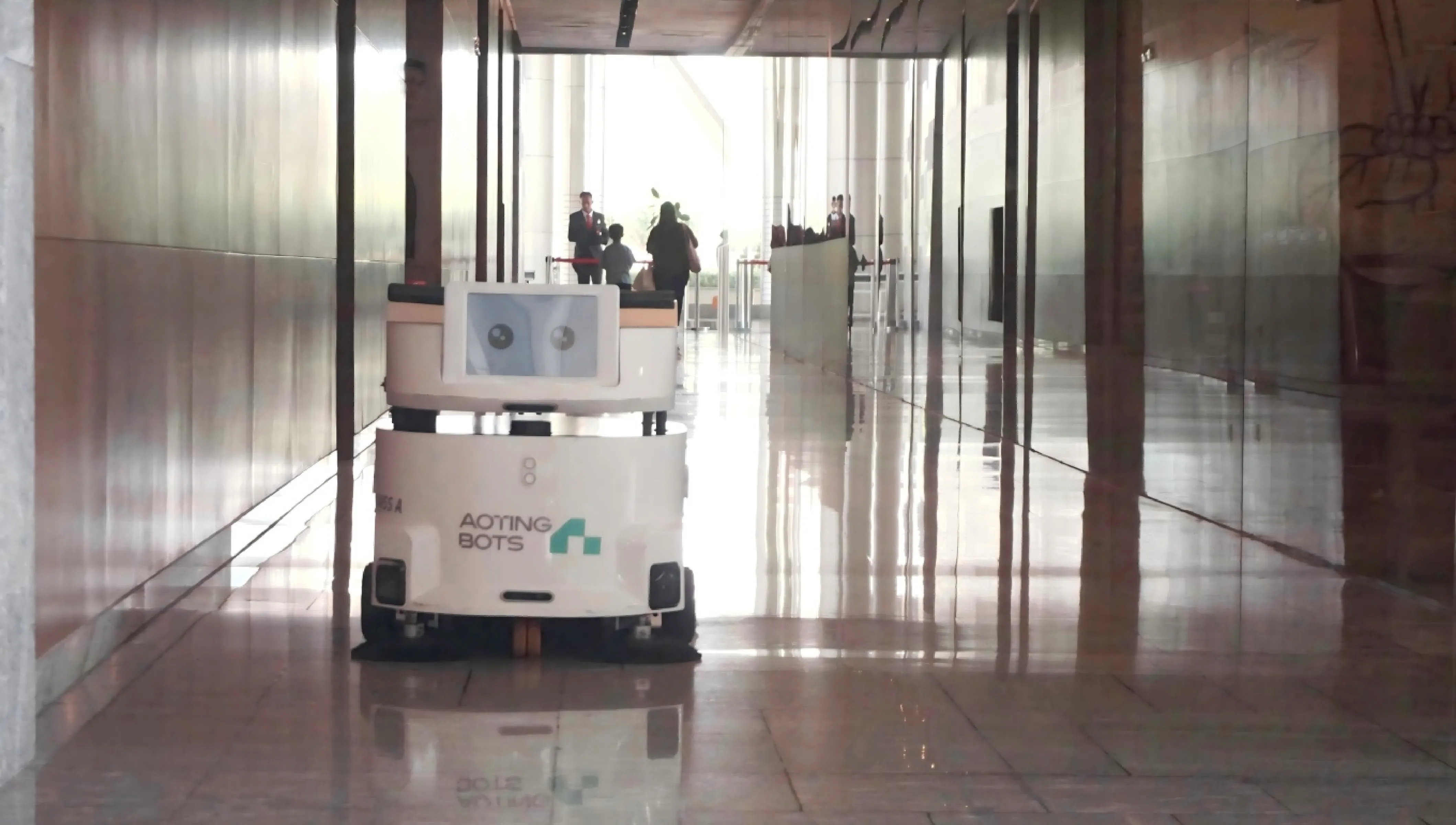
Arrange a supervised pilot with moving luggage, trolleys and an occupied corridor. Track time spent stopped, route detours, edge cleaning and areas left incomplete. A robot can be fast in an empty terminal and ineffective if every passenger group blocks its intended path. Consider distinct schedules for late evening, early morning and peak departures.
The competitor example from Avidbots' airport cleaning operations discussion illustrates why terminal operators focus on staff allocation, scheduling and operational reporting. Those ideas are useful evaluation criteria, not proof that one manufacturer's product will deliver the same outcomes as another.
Charging locations, service access and software connectivity may require review by airport facilities, IT and security teams. Set no-go areas around security-critical zones and ensure local staff can stop and recover the machine. Request a clear policy for data collected during mapping and route operation, including retention and access permissions.
For workplace floor conditions in US facilities, OSHA 29 CFR 1910.22 is relevant context. Applicable airport operational rules and local safety requirements must be reviewed separately.
Useful indicators include square metres actually cleaned, route-completion rate, number of interventions, time spent in blocked zones, service time and a visual inspection of the finished floor. The manufacturer's theoretical cleaning efficiency is just a planning input. Track how much of the required floor programme was completed without creating new operational problems.
A pilot should also clarify responsibilities when schedules change: who adjusts the route, who approves a new zone and who handles a machine that cannot return to its charger.
After one departure boards, a gate concourse may be comparatively clear for a short time. It may become busy again when the next flight arrives, or a gate change may introduce passengers unexpectedly. Terminal operations should define how cleaning tasks are paused or rerouted when that happens. Test who has authority to change the schedule and how the team verifies that any skipped floor area is cleaned later. A robot that can be stopped safely and managed transparently may be more valuable than one with a faster published cleaning speed but poor operational coordination.
Potentially in approved locations, but a terminal needs route planning, supervision during testing and assessment of pedestrian interaction. Some high-density areas may not be suitable during opening hours.
No. Terminal geometry, access points and crowd patterns can matter more than the maximum cleaning width.
An airport cleaning robot faces long operating hours, unpredictable passenger flow and a complicated mix of open space and bottlenecks. Terminals may look spacious, but baggage queues, security approaches and gate changes leave far less usable floor area than a plan suggests. Procurement should begin with route management and safety, not machine size alone.
Separate check-in halls, departure concourses, gate seating areas, baggage-claim zones and staff corridors. Each has different traffic behaviour. Long corridors may offer efficient automated runs, while security lines and crowded gates frequently require exclusions or off-peak cleaning. Escalators, stairs, tactile surfaces and moving walkways need clear boundaries and suitable site controls.
An airport cleaning route also needs a response plan for a sudden crowd, a changed boarding gate or equipment placed in the path. Frequent interruptions may be a sign that the zone schedule needs adjustment rather than that the robot lacks theoretical coverage.
Tracked-in dust, dry grit and lightweight debris differ from drink spills or winter moisture. AotingBots' SW55 A is a compact, waterless machine that suits segmented or narrower terminal zones, and it is often the easier model to trial first. When evaluating larger halls and long concourse runs, focus on the machine's working width, tank or debris capacity and turn-around behaviour at the ends of each run, rather than on a single headline specification — and confirm the chosen configuration matches the terminal's actual floor finishes and local procedures for wet contamination.
No cleaning robot should be promoted as a disinfecting machine solely because it removes visible debris. Keep cleaning and hygiene responsibilities separate.
Arrange a supervised pilot with moving luggage, trolleys and an occupied corridor. Track time spent stopped, route detours, edge cleaning and areas left incomplete. A robot can be fast in an empty terminal and ineffective if every passenger group blocks its intended path. Consider distinct schedules for late evening, early morning and peak departures.
The competitor example from Avidbots' airport cleaning operations discussion illustrates why terminal operators focus on staff allocation, scheduling and operational reporting. Those ideas are useful evaluation criteria, not proof that one manufacturer's product will deliver the same outcomes as another.
Charging locations, service access and software connectivity may require review by airport facilities, IT and security teams. Set no-go areas around security-critical zones and ensure local staff can stop and recover the machine. Request a clear policy for data collected during mapping and route operation, including retention and access permissions.
For workplace floor conditions in US facilities, OSHA 29 CFR 1910.22 is relevant context. Applicable airport operational rules and local safety requirements must be reviewed separately.
Useful indicators include square metres actually cleaned, route-completion rate, number of interventions, time spent in blocked zones, service time and a visual inspection of the finished floor. The manufacturer's theoretical cleaning efficiency is just a planning input. Track how much of the required floor programme was completed without creating new operational problems.
A pilot should also clarify responsibilities when schedules change: who adjusts the route, who approves a new zone and who handles a machine that cannot return to its charger.
After one departure boards, a gate concourse may be comparatively clear for a short time. It may become busy again when the next flight arrives, or a gate change may introduce passengers unexpectedly. Terminal operations should define how cleaning tasks are paused or rerouted when that happens. Test who has authority to change the schedule and how the team verifies that any skipped floor area is cleaned later. A robot that can be stopped safely and managed transparently may be more valuable than one with a faster published cleaning speed but poor operational coordination.
Potentially in approved locations, but a terminal needs route planning, supervision during testing and assessment of pedestrian interaction. Some high-density areas may not be suitable during opening hours.
No. Terminal geometry, access points and crowd patterns can matter more than the maximum cleaning width.
CONTACT US
we aim to become a global leader in manufacturer space service robotics and artificial intelligence.


