
CONTACT US
SEARCH WHAT YOU WANT
Hotel housekeeping runs to a different timetable from office or warehouse cleaning. A guest can arrive before check-in, luggage may be left in corridors and quiet hours constrain how equipment is used. A hotel cleaning robot must fit those routines, rather than require housekeeping to rearrange the property around the machine.
Walk from the entrance through the lobby, lift area, conference corridor and any restaurant approach. Record changes from hard flooring to carpet, mats and thresholds. Identify places where equipment would feel intrusive: narrow hallways, reception queues and doorways to meeting rooms. Public floors can be good candidates for routine debris removal, but guestrooms, bathrooms and detailed furniture cleaning remain separate tasks.
The largest mapped area is not necessarily the best starting point. A quiet conference wing with repeatable routes may give a more informative pilot than a constantly changing lobby.
Choose brushes and settings after checking floor finishes with the property team. Carpet pile, polished stone and wood finishes have different tolerances for mechanical contact. A waterless robot can help collect tracked-in dirt and loose particles, but spills and disinfection requirements need their own procedures.
AotingBots positions the SW55 A for hotels and other commercial interiors. Its compact dimensions and listed noise level of no more than 62 dB(A) make it a candidate for evaluation where access and noise are concerns. The larger SW80 A may suit large conference or exhibition areas within a resort, provided the routes are wide enough.
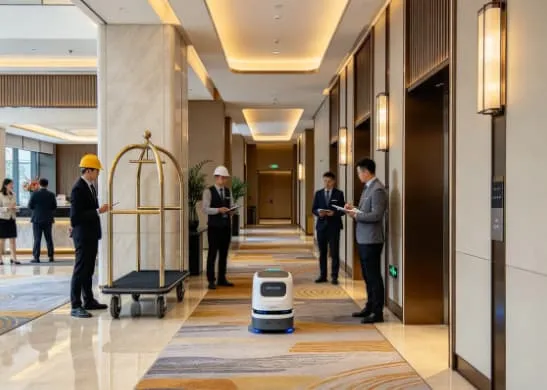
A trial should include a luggage trolley, normal foot traffic and a transition between floor surfaces. Observe the robot's response to changing obstacles and whether it leaves an acceptable finish along the lobby edges. Time how long it takes to service the waste container and restart a route after an interruption.
If the hotel has lifts and access-controlled floors, discuss the building system before promising fully autonomous movement between levels. SW55 A's product information mentions integration capabilities, but technical compatibility depends on the equipment installed at the property.
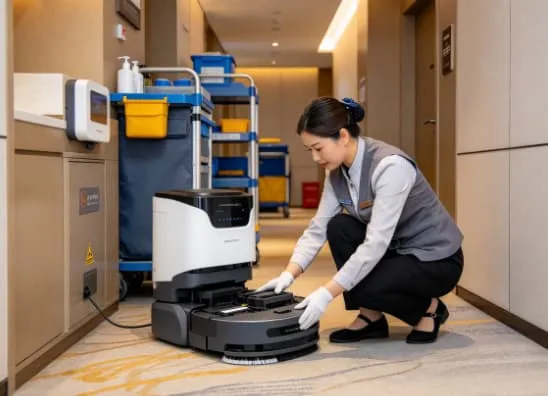
Place charging and maintenance equipment where staff can access it without blocking exits, lifts or guest paths. Define who is responsible for emptying the debris container and which shifts will inspect sensors and brushes. Keep the machine's emergency stop and manual operating instructions available to the team.
Hospitality managers often prefer an equipment plan that staff can use without calling a specialist every day. IFMA's facility management resources highlight the broader importance of maintaining usable operational procedures and records; a robot should join that system, not create an isolated process.
The US EPA distinguishes cleaning from sanitizing and disinfecting. A hotel using dry floor cleaning still needs its established procedures for spills and surfaces requiring specific treatment. This distinction belongs in staff training and guest-facing descriptions.
Record route completion, number of stops, staff servicing time, noise feedback, appearance after cleaning and areas that still require manual attention. Compare results across weekday and weekend traffic if the property changes significantly. Include feedback from housekeeping and front-desk teams; a robot that works technically but obstructs guests will be hard to keep in use.
A hotel may have a mostly quiet second-floor conference corridor until several hundred delegates leave an event at once. That same corridor is an attractive cleaning route between sessions and a poor choice during the break. A useful pilot should therefore cover both ordinary and peak periods. Record how the machine responds when its path is temporarily crowded and whether cleaning resumes as expected. Share the results with the events team so the schedule follows actual bookings rather than a fixed time that repeatedly conflicts with guest movement.
The models discussed here are positioned primarily for routine floor work in public and shared areas. Guestroom suitability would require separate assessment and is not established by those product specifications.
Not always. Quiet hours, staff availability and guest circulation differ by property. Test the schedule that will actually be used.
A successful hotel deployment is usually an unremarkable one: clean public floors, clear guest routes and a housekeeping team that can operate the equipment confidently.
Hotel housekeeping runs to a different timetable from office or warehouse cleaning. A guest can arrive before check-in, luggage may be left in corridors and quiet hours constrain how equipment is used. A hotel cleaning robot must fit those routines, rather than require housekeeping to rearrange the property around the machine.
Walk from the entrance through the lobby, lift area, conference corridor and any restaurant approach. Record changes from hard flooring to carpet, mats and thresholds. Identify places where equipment would feel intrusive: narrow hallways, reception queues and doorways to meeting rooms. Public floors can be good candidates for routine debris removal, but guestrooms, bathrooms and detailed furniture cleaning remain separate tasks.
The largest mapped area is not necessarily the best starting point. A quiet conference wing with repeatable routes may give a more informative pilot than a constantly changing lobby.
Choose brushes and settings after checking floor finishes with the property team. Carpet pile, polished stone and wood finishes have different tolerances for mechanical contact. A waterless robot can help collect tracked-in dirt and loose particles, but spills and disinfection requirements need their own procedures.
AotingBots positions the SW55 A for hotels and other commercial interiors. Its compact dimensions and listed noise level of no more than 62 dB(A) make it a candidate for evaluation where access and noise are concerns. The larger SW80 A may suit large conference or exhibition areas within a resort, provided the routes are wide enough.
A trial should include a luggage trolley, normal foot traffic and a transition between floor surfaces. Observe the robot's response to changing obstacles and whether it leaves an acceptable finish along the lobby edges. Time how long it takes to service the waste container and restart a route after an interruption.
If the hotel has lifts and access-controlled floors, discuss the building system before promising fully autonomous movement between levels. SW55 A's product information mentions integration capabilities, but technical compatibility depends on the equipment installed at the property.
Place charging and maintenance equipment where staff can access it without blocking exits, lifts or guest paths. Define who is responsible for emptying the debris container and which shifts will inspect sensors and brushes. Keep the machine's emergency stop and manual operating instructions available to the team.
Hospitality managers often prefer an equipment plan that staff can use without calling a specialist every day. IFMA's facility management resources highlight the broader importance of maintaining usable operational procedures and records; a robot should join that system, not create an isolated process.
The US EPA distinguishes cleaning from sanitizing and disinfecting. A hotel using dry floor cleaning still needs its established procedures for spills and surfaces requiring specific treatment. This distinction belongs in staff training and guest-facing descriptions.
Record route completion, number of stops, staff servicing time, noise feedback, appearance after cleaning and areas that still require manual attention. Compare results across weekday and weekend traffic if the property changes significantly. Include feedback from housekeeping and front-desk teams; a robot that works technically but obstructs guests will be hard to keep in use.
A hotel may have a mostly quiet second-floor conference corridor until several hundred delegates leave an event at once. That same corridor is an attractive cleaning route between sessions and a poor choice during the break. A useful pilot should therefore cover both ordinary and peak periods. Record how the machine responds when its path is temporarily crowded and whether cleaning resumes as expected. Share the results with the events team so the schedule follows actual bookings rather than a fixed time that repeatedly conflicts with guest movement.
The models discussed here are positioned primarily for routine floor work in public and shared areas. Guestroom suitability would require separate assessment and is not established by those product specifications.
Not always. Quiet hours, staff availability and guest circulation differ by property. Test the schedule that will actually be used.
A successful hotel deployment is usually an unremarkable one: clean public floors, clear guest routes and a housekeeping team that can operate the equipment confidently.
CONTACT US
we aim to become a global leader in manufacturer space service robotics and artificial intelligence.


