
CONTACT US
SEARCH WHAT YOU WANT
An office building cleaning robot can automate routine floor maintenance in lobbies, corridors, reception areas, and shared workspaces. The right solution depends on floor materials, building layout, pedestrian traffic, operating hours, and cleaning frequency.
Unlike warehouses or factories, office buildings require cleaning equipment that can operate around employees, visitors, furniture, and sensitive working environments. Noise, navigation accuracy, and minimal disruption are therefore important selection factors.
Autonomous cleaning is most effective when robots handle predictable floor-cleaning routes while cleaning staff manage tasks requiring human judgment, such as desk cleaning, washrooms, and detailed surface maintenance.
Not every office area offers the same operating conditions. Open spaces and long corridors generally provide more predictable routes than furnished meeting rooms or crowded workstations.
A practical deployment plan should divide the building into cleaning zones.
| Office Area | Cleaning Requirements | Robot Suitability |
|---|---|---|
| Main lobby | Frequent dust and debris removal | High |
| Reception area | Clean floors around furniture and visitors | High, with route adjustments |
| Corridors | Repeated cleaning along long pathways | High |
| Open-plan offices | Cleaning around desks and chairs | Moderate to high |
| Meeting rooms | Flexible scheduling around occupancy | Moderate |
| Cafeteria | Food particles and changing obstacles | Requires assessment |
| Staircases | Steps and vertical transitions | Not suitable for standard floor robots |
| Washrooms | Detailed sanitation and fixture cleaning | Requires dedicated cleaning methods |
Lobbies and reception areas are practical starting points because they experience regular pedestrian movement and visible dirt accumulation.
Corridors also offer relatively consistent cleaning routes. Their suitability depends on available width, door positions, furniture placement, and pedestrian traffic.
Open-plan offices require more careful mapping. Chairs, cables, temporary storage, and personal belongings can change the available cleaning space throughout the day.
Meeting rooms are better suited to scheduled cleaning when occupants have left. This reduces interruptions and makes route planning more predictable.
The Singapore National Environment Agency's 2026 cleaning guidance distinguishes premises by their suitability for autonomous robots. It identifies open atriums and corridors as highly suitable, while cluttered rooms and high-traffic spaces require more consideration.
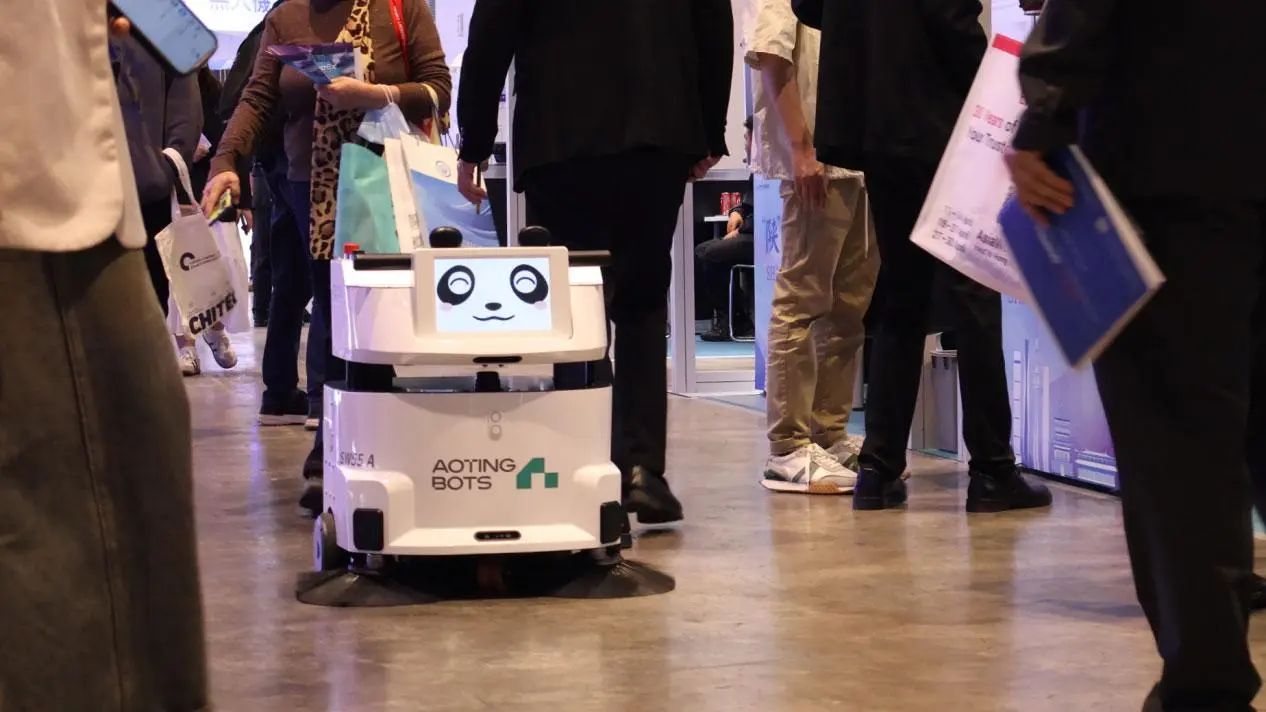
Selecting equipment should begin with the building's actual cleaning conditions rather than the largest advertised cleaning capacity.
Five technical factors deserve particular attention.
Office buildings commonly combine several floor materials:
Marble and artificial stone in reception areas.
Ceramic tiles and terrazzo in corridors.
Hardwood or engineered wood in executive spaces.
Short-pile carpets in offices and meeting rooms.
Plastic and other resilient flooring in shared facilities.
A robot must be suitable for the specific surfaces it will encounter. Carpet thickness, floor transitions, surface finishes, and cleaning methods can influence performance.
For mixed-floor environments, evaluate whether one machine can handle the required surfaces or whether different cleaning arrangements are necessary.
A waterless cleaning robot can be useful where operators want to combine sweeping, vacuuming, and dust mopping without introducing wastewater into routine floor maintenance.
However, waterless cleaning should not be confused with deep carpet extraction or specialist stain treatment. Those tasks may still require conventional equipment.
Noise is a major consideration in occupied office buildings.
Cleaning activities may take place near reception desks, conference rooms, telephone areas, and employee workstations.
Compare the equipment's published operating noise level and test it in the actual environment. Noise can vary according to cleaning mode, floor material, brush condition, and operating conditions.
For example, the AotingBots SW55 A commercial cleaning robot has a published noise level of ≤62 dB(A). It also provides a silent operating mode for environments where noise management matters.
The appropriate operating schedule should still be determined through an on-site trial.
Office environments change throughout the day.
Employees move chairs, visitors enter reception areas, cleaning carts occupy corridors, and temporary objects appear along established routes.
An office building cleaning robot should provide reliable mapping, positioning, and obstacle detection.
Evaluate:
Laser-based navigation and positioning.
Real-time obstacle detection.
Route planning and map updates.
Restricted-zone management.
Automatic route recovery.
Manual intervention options.
Navigation should be tested during both quiet and busy periods.
Pay particular attention to glass partitions, reflective surfaces, narrow passages, entrance mats, and low-level obstacles. These conditions can affect perception and route execution.
Battery endurance determines how a robot can be scheduled across different building zones.
Buyers should distinguish between advertised cleaning efficiency and actual completed coverage. Published productivity figures may not account for interruptions, obstacles, route changes, and charging.
Consider the following:
| Parameter | Why It Matters |
|---|---|
| Cleaning efficiency | Indicates potential area coverage |
| Battery endurance | Determines available operating time |
| Charging time | Affects daily scheduling |
| Cleaning width | Influences route efficiency |
| Waste capacity | Determines maintenance frequency |
| Mapping capacity | Supports larger or changing layouts |
A robot with higher theoretical productivity is not necessarily the better option. A compact machine that can navigate office furniture and complete scheduled routes may provide better operational suitability.
Multi-floor office buildings introduce additional requirements.
Robots may need to interact with elevators, access gates, and controlled building entrances. These functions depend on compatible interfaces and the building's existing infrastructure.
Before selecting equipment, confirm:
Whether elevator control is supported.
Whether access-control integration is available.
Whether Wi-Fi coverage is sufficient.
Whether charging locations are accessible.
Whether remote task monitoring is supported.
Whether multiple users require different permissions.
The National Environment Agency also highlights remotely operated lifts and doors, sufficient maneuvering space, stable Wi-Fi, and charging infrastructure as important deployment considerations.
Successful deployment requires more than switching on the machine and creating a map.
A structured implementation process helps facility managers identify unsuitable areas and establish workable cleaning schedules.
Step 1: Conduct a site assessment
Inspect the intended cleaning areas and document floor materials, corridor widths, doorways, furniture, floor transitions, and pedestrian traffic.
Identify restricted areas and potential navigation obstacles before mapping begins.
Step 2: Divide the building into cleaning zones
Separate the lobby, corridors, open offices, and meeting areas into manageable routes.
Assign different cleaning schedules according to occupancy and cleaning frequency.
Step 3: Configure maps and operating schedules
Create cleaning routes and define restricted zones. Set different operating speeds and schedules where supported by the equipment.
For occupied offices, prioritize predictable routes and avoid unnecessary movement near employees.
Step 4: Test the robot under real conditions
Run trial cleaning sessions during representative working periods.
Record completed areas, missed sections, obstacle-related interruptions, charging frequency, and manual intervention.
Step 5: Train cleaning and facility staff
Staff should understand operation, emergency stops, waste disposal, charging, routine maintenance, and basic troubleshooting.
Establish clear responsibilities for responding to operational alerts.
Step 6: Review performance and adjust routes
Use cleaning reports and site inspections to identify incomplete areas and recurring interruptions.
Update routes when furniture layouts or building operations change.
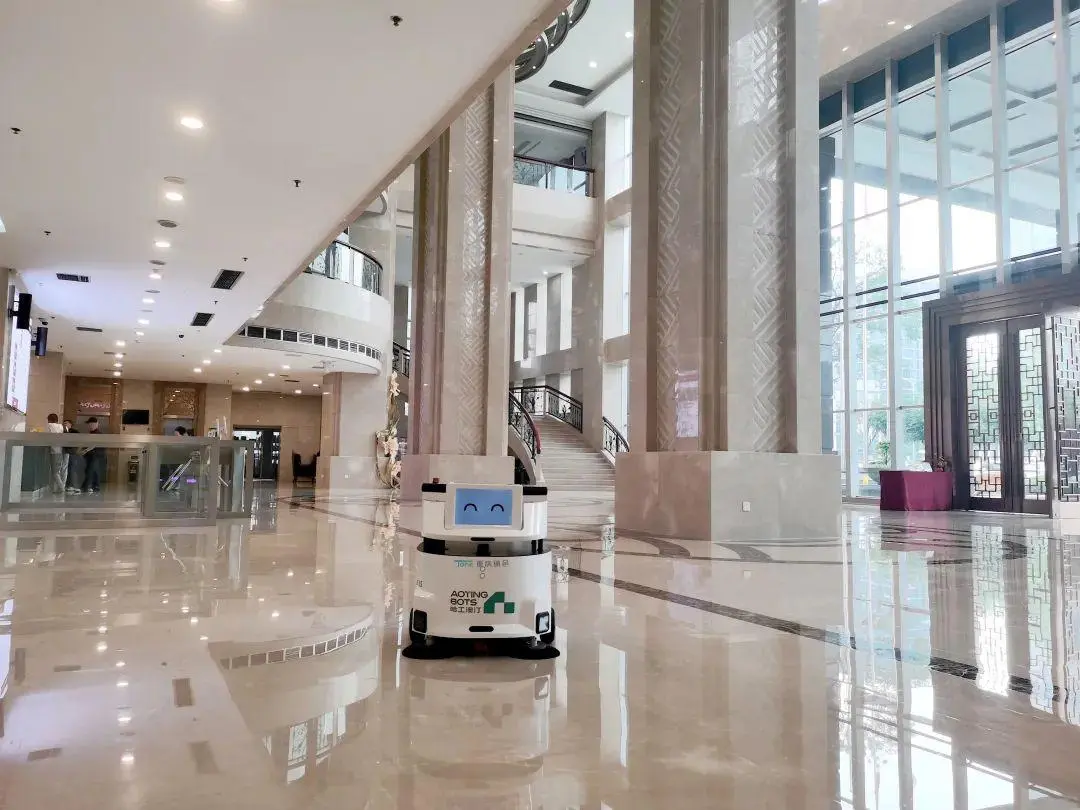
When evaluating an office building cleaning robot, the AotingBots SW55 A is a relevant model to consider for medium and small-scale commercial environments.
Its published specifications include:
| Technical Parameter | SW55 A |
|---|---|
| Dimensions | 615 × 585 × 650 mm |
| Robot weight | 91 kg |
| Cleaning efficiency | 1,200 m²/h |
| Cleaning path | 615 / 705 mm |
| Battery capacity | 52 Ah |
| Hard-floor endurance | Up to 12 hours |
| Silent-mode endurance | Up to 16.5 hours |
| Charging time | 2 hours |
| Noise level | ≤62 dB(A) |
| Maximum mapping area | 40,000 m² |
These are manufacturer-published specifications, not guaranteed daily cleaning results.
The SW55 A integrates four cleaning functions:
Scrubbing.
Sweeping.
Vacuuming.
Dust mopping.
Its waterless cleaning design is intended for commercial indoor environments. The product supports hard floors, wooden flooring, and carpets, subject to surface suitability.
Other relevant capabilities include:
0 cm edge-cleaning technology.
360-degree laser and multi-sensor positioning.
Real-time map updating.
Elevator and access-control integration support.
Remote task management and cleaning reports.
Optional security monitoring and inspection functions.
The compact dimensions are worth considering for office corridors and furnished spaces. However, actual passage clearance and turning space must be checked during the site survey.
The product's application information specifically includes office buildings, hotels, shopping malls, and conference centers.
For wider equipment comparisons, buyers can explore the AotingBots commercial cleaning robot range and review the autonomous cleaning robot selection criteria.
AotingBots also documents an office complex deployment in Jakarta, Indonesia, presented at the 2026 CCE Shanghai cleaning industry event. This provides an additional commercial-building application reference. Read about the office building deployment.
For facility managers, the next step is to compare the published specifications against actual floor conditions, operating schedules, and building infrastructure rather than selecting equipment by capacity alone.
Yes. Commercial cleaning robots can operate in occupied buildings when routes, operating speeds, and schedules are configured around pedestrian traffic. Busy areas may require additional supervision.
Lobbies, reception areas, open corridors, and large shared spaces are practical starting points. They generally provide more predictable routes than small furnished rooms.
Some commercial models support multiple floor materials. Compatibility depends on carpet construction, surface condition, cleaning functions, and manufacturer specifications.
Noise varies by model and operating mode. Buyers should compare published dB(A) ratings and conduct trials in occupied workspaces before establishing regular schedules.
Some models support elevator control and access-control integration. Compatibility depends on the robot's interface, elevator control system, and building security arrangements.
The frequency depends on foot traffic, floor materials, occupancy, and cleaning standards. Lobbies and entrances may require more frequent cleaning than private offices or meeting rooms.
They are better viewed as tools for automating repeatable floor-maintenance tasks. Human staff remain important for detailed cleaning, washrooms, spill response, and tasks involving complex judgment.
Review floor compatibility, navigation, noise, battery endurance, charging arrangements, access restrictions, and maintenance requirements. A site trial helps confirm whether published specifications translate into practical performance.
1. AotingBots SW55 A Official Product Page — Product specifications, cleaning functions, and office building applications.
2. Singapore NEA: Guide on Specifications for Outcome-based Cleaning Contracts, Third Edition (2026) — Robot suitability, facility infrastructure, and cleaning deployment considerations.
3. AotingBots: Office Building Deployment Case in Jakarta — Commercial office complex application reference.
4. Autonomous Cleaning Robot for Commercial Buildings: Selection Criteria — Additional selection and deployment considerations.
An office building cleaning robot can automate routine floor maintenance in lobbies, corridors, reception areas, and shared workspaces. The right solution depends on floor materials, building layout, pedestrian traffic, operating hours, and cleaning frequency.
Unlike warehouses or factories, office buildings require cleaning equipment that can operate around employees, visitors, furniture, and sensitive working environments. Noise, navigation accuracy, and minimal disruption are therefore important selection factors.
Autonomous cleaning is most effective when robots handle predictable floor-cleaning routes while cleaning staff manage tasks requiring human judgment, such as desk cleaning, washrooms, and detailed surface maintenance.
Not every office area offers the same operating conditions. Open spaces and long corridors generally provide more predictable routes than furnished meeting rooms or crowded workstations.
A practical deployment plan should divide the building into cleaning zones.
| Office Area | Cleaning Requirements | Robot Suitability |
|---|---|---|
| Main lobby | Frequent dust and debris removal | High |
| Reception area | Clean floors around furniture and visitors | High, with route adjustments |
| Corridors | Repeated cleaning along long pathways | High |
| Open-plan offices | Cleaning around desks and chairs | Moderate to high |
| Meeting rooms | Flexible scheduling around occupancy | Moderate |
| Cafeteria | Food particles and changing obstacles | Requires assessment |
| Staircases | Steps and vertical transitions | Not suitable for standard floor robots |
| Washrooms | Detailed sanitation and fixture cleaning | Requires dedicated cleaning methods |
Lobbies and reception areas are practical starting points because they experience regular pedestrian movement and visible dirt accumulation.
Corridors also offer relatively consistent cleaning routes. Their suitability depends on available width, door positions, furniture placement, and pedestrian traffic.
Open-plan offices require more careful mapping. Chairs, cables, temporary storage, and personal belongings can change the available cleaning space throughout the day.
Meeting rooms are better suited to scheduled cleaning when occupants have left. This reduces interruptions and makes route planning more predictable.
The Singapore National Environment Agency's 2026 cleaning guidance distinguishes premises by their suitability for autonomous robots. It identifies open atriums and corridors as highly suitable, while cluttered rooms and high-traffic spaces require more consideration.
Selecting equipment should begin with the building's actual cleaning conditions rather than the largest advertised cleaning capacity.
Five technical factors deserve particular attention.
Office buildings commonly combine several floor materials:
Marble and artificial stone in reception areas.
Ceramic tiles and terrazzo in corridors.
Hardwood or engineered wood in executive spaces.
Short-pile carpets in offices and meeting rooms.
Plastic and other resilient flooring in shared facilities.
A robot must be suitable for the specific surfaces it will encounter. Carpet thickness, floor transitions, surface finishes, and cleaning methods can influence performance.
For mixed-floor environments, evaluate whether one machine can handle the required surfaces or whether different cleaning arrangements are necessary.
A waterless cleaning robot can be useful where operators want to combine sweeping, vacuuming, and dust mopping without introducing wastewater into routine floor maintenance.
However, waterless cleaning should not be confused with deep carpet extraction or specialist stain treatment. Those tasks may still require conventional equipment.
Noise is a major consideration in occupied office buildings.
Cleaning activities may take place near reception desks, conference rooms, telephone areas, and employee workstations.
Compare the equipment's published operating noise level and test it in the actual environment. Noise can vary according to cleaning mode, floor material, brush condition, and operating conditions.
For example, the AotingBots SW55 A commercial cleaning robot has a published noise level of ≤62 dB(A). It also provides a silent operating mode for environments where noise management matters.
The appropriate operating schedule should still be determined through an on-site trial.
Office environments change throughout the day.
Employees move chairs, visitors enter reception areas, cleaning carts occupy corridors, and temporary objects appear along established routes.
An office building cleaning robot should provide reliable mapping, positioning, and obstacle detection.
Evaluate:
Laser-based navigation and positioning.
Real-time obstacle detection.
Route planning and map updates.
Restricted-zone management.
Automatic route recovery.
Manual intervention options.
Navigation should be tested during both quiet and busy periods.
Pay particular attention to glass partitions, reflective surfaces, narrow passages, entrance mats, and low-level obstacles. These conditions can affect perception and route execution.
Battery endurance determines how a robot can be scheduled across different building zones.
Buyers should distinguish between advertised cleaning efficiency and actual completed coverage. Published productivity figures may not account for interruptions, obstacles, route changes, and charging.
Consider the following:
| Parameter | Why It Matters |
|---|---|
| Cleaning efficiency | Indicates potential area coverage |
| Battery endurance | Determines available operating time |
| Charging time | Affects daily scheduling |
| Cleaning width | Influences route efficiency |
| Waste capacity | Determines maintenance frequency |
| Mapping capacity | Supports larger or changing layouts |
A robot with higher theoretical productivity is not necessarily the better option. A compact machine that can navigate office furniture and complete scheduled routes may provide better operational suitability.
Multi-floor office buildings introduce additional requirements.
Robots may need to interact with elevators, access gates, and controlled building entrances. These functions depend on compatible interfaces and the building's existing infrastructure.
Before selecting equipment, confirm:
Whether elevator control is supported.
Whether access-control integration is available.
Whether Wi-Fi coverage is sufficient.
Whether charging locations are accessible.
Whether remote task monitoring is supported.
Whether multiple users require different permissions.
The National Environment Agency also highlights remotely operated lifts and doors, sufficient maneuvering space, stable Wi-Fi, and charging infrastructure as important deployment considerations.
Successful deployment requires more than switching on the machine and creating a map.
A structured implementation process helps facility managers identify unsuitable areas and establish workable cleaning schedules.
Step 1: Conduct a site assessment
Inspect the intended cleaning areas and document floor materials, corridor widths, doorways, furniture, floor transitions, and pedestrian traffic.
Identify restricted areas and potential navigation obstacles before mapping begins.
Step 2: Divide the building into cleaning zones
Separate the lobby, corridors, open offices, and meeting areas into manageable routes.
Assign different cleaning schedules according to occupancy and cleaning frequency.
Step 3: Configure maps and operating schedules
Create cleaning routes and define restricted zones. Set different operating speeds and schedules where supported by the equipment.
For occupied offices, prioritize predictable routes and avoid unnecessary movement near employees.
Step 4: Test the robot under real conditions
Run trial cleaning sessions during representative working periods.
Record completed areas, missed sections, obstacle-related interruptions, charging frequency, and manual intervention.
Step 5: Train cleaning and facility staff
Staff should understand operation, emergency stops, waste disposal, charging, routine maintenance, and basic troubleshooting.
Establish clear responsibilities for responding to operational alerts.
Step 6: Review performance and adjust routes
Use cleaning reports and site inspections to identify incomplete areas and recurring interruptions.
Update routes when furniture layouts or building operations change.
When evaluating an office building cleaning robot, the AotingBots SW55 A is a relevant model to consider for medium and small-scale commercial environments.
Its published specifications include:
| Technical Parameter | SW55 A |
|---|---|
| Dimensions | 615 × 585 × 650 mm |
| Robot weight | 91 kg |
| Cleaning efficiency | 1,200 m²/h |
| Cleaning path | 615 / 705 mm |
| Battery capacity | 52 Ah |
| Hard-floor endurance | Up to 12 hours |
| Silent-mode endurance | Up to 16.5 hours |
| Charging time | 2 hours |
| Noise level | ≤62 dB(A) |
| Maximum mapping area | 40,000 m² |
These are manufacturer-published specifications, not guaranteed daily cleaning results.
The SW55 A integrates four cleaning functions:
Scrubbing.
Sweeping.
Vacuuming.
Dust mopping.
Its waterless cleaning design is intended for commercial indoor environments. The product supports hard floors, wooden flooring, and carpets, subject to surface suitability.
Other relevant capabilities include:
0 cm edge-cleaning technology.
360-degree laser and multi-sensor positioning.
Real-time map updating.
Elevator and access-control integration support.
Remote task management and cleaning reports.
Optional security monitoring and inspection functions.
The compact dimensions are worth considering for office corridors and furnished spaces. However, actual passage clearance and turning space must be checked during the site survey.
The product's application information specifically includes office buildings, hotels, shopping malls, and conference centers.
For wider equipment comparisons, buyers can explore the AotingBots commercial cleaning robot range and review the autonomous cleaning robot selection criteria.
AotingBots also documents an office complex deployment in Jakarta, Indonesia, presented at the 2026 CCE Shanghai cleaning industry event. This provides an additional commercial-building application reference. Read about the office building deployment.
For facility managers, the next step is to compare the published specifications against actual floor conditions, operating schedules, and building infrastructure rather than selecting equipment by capacity alone.
Yes. Commercial cleaning robots can operate in occupied buildings when routes, operating speeds, and schedules are configured around pedestrian traffic. Busy areas may require additional supervision.
Lobbies, reception areas, open corridors, and large shared spaces are practical starting points. They generally provide more predictable routes than small furnished rooms.
Some commercial models support multiple floor materials. Compatibility depends on carpet construction, surface condition, cleaning functions, and manufacturer specifications.
Noise varies by model and operating mode. Buyers should compare published dB(A) ratings and conduct trials in occupied workspaces before establishing regular schedules.
Some models support elevator control and access-control integration. Compatibility depends on the robot's interface, elevator control system, and building security arrangements.
The frequency depends on foot traffic, floor materials, occupancy, and cleaning standards. Lobbies and entrances may require more frequent cleaning than private offices or meeting rooms.
They are better viewed as tools for automating repeatable floor-maintenance tasks. Human staff remain important for detailed cleaning, washrooms, spill response, and tasks involving complex judgment.
Review floor compatibility, navigation, noise, battery endurance, charging arrangements, access restrictions, and maintenance requirements. A site trial helps confirm whether published specifications translate into practical performance.
1. AotingBots SW55 A Official Product Page — Product specifications, cleaning functions, and office building applications.
2. Singapore NEA: Guide on Specifications for Outcome-based Cleaning Contracts, Third Edition (2026) — Robot suitability, facility infrastructure, and cleaning deployment considerations.
3. AotingBots: Office Building Deployment Case in Jakarta — Commercial office complex application reference.
4. Autonomous Cleaning Robot for Commercial Buildings: Selection Criteria — Additional selection and deployment considerations.
CONTACT US
we aim to become a global leader in manufacturer space service robotics and artificial intelligence.


